
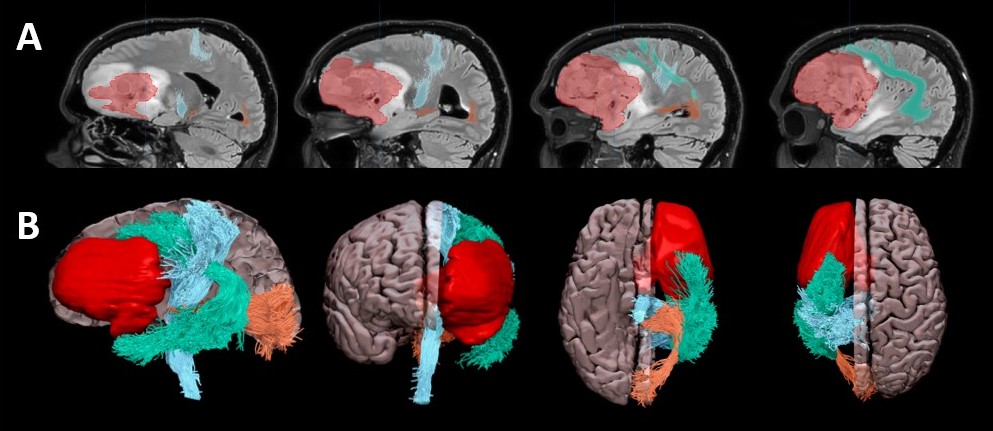
Despite informing on the location of functionally relevant white matter tracts, diffusion MRI tractography is not routinely used to guide neurosurgical procedures. The potential of tractography to help avoid postoperative neurological deficits is not yet fully established.The objective of our study was to assess whether surgeries that incorporated tractography, either alone or in conjunction with other modalities, are associated with a lower risk of long-term postoperative neurological deficits in patients undergoing resective/ablative intracranial procedures. We performed a systematic review with meta-analysis, searching through EMBASE and PubMed databases for all peer-reviewed articles published in English up until December 2024. Studies were included if they reported on intracranial resective or ablative surgeries, if they compared tractography-assisted against non-tractography-assisted approaches, and if they assessed new postoperative neurological deficits. No restrictions were placed on the age of patients. Studies were assessed for inclusion by two independent reviewers and disagreements were settled by a third. Data extraction was performed according to PRISMA guidelines, quality of studies was evaluated using the GRADE Framework, and risk of bias was assessed through a modified version of the Newcastle-Ottawa Quality Assessment Scale for cohort studies. Data were pooled using a random-effects model with a Mantel-Haenszel method for estimating risk ratios. The primary outcome consisted in any neurological deficits present at last follow-up ({greater than or equal to} 3 months). Out of 5315 studies initially identified, eight were included after all stages of review, all of which consisted of resective surgeries. A meta-analysis of 629 patients revealed a 55% risk reduction of postoperative neurological deficits when incorporating tractography in the neurosurgical workflow. This benefit was consistent when assessing studies where tractography was exclusively used preoperatively. Further, the incorporation of tractography into intraoperative neuronavigation systems was associated with lower proportions of postoperative neurological deficits, compared to exclusively preoperative tractography. These benefits were found to be present in severaladditional subgroup and sensitivity analyses. The addition of tractography is associated with a reduced risk of postoperative neurological deficits in intracranial resective surgeries. Tractography can complement gold standard brain mapping methods such as direct electrical stimulation during awake surgeries or serve as a helpfulalternative when electrical stimulation is contraindicated.
Guido I. Guberman; Neevya Balasubramaniam; Liam Wilson; Etienne J. P. Maes; Judy Chen; Mimosa Luigi; Guillaume Theaud; Francois Rheault; Elie Bou Assi; Hitten P Zaveri; HarrisonWestwick; Dang K. Nguyen; Alain Bouthillier; Michel W. Bojanowski; Alexander G. Weil; Roy W.R. Dudley; Boris C. Bernhardt; Joseph Yuan-Mou Yang; Maxime Descoteaux; Eyiyemisi Damisah George M. Ibrahim; Dennis D. Spencer; Silvio Sarubbo; Sami Obaid